



When Governance Goes Wrong: What Pacific Boards Can Learn from ASIC v Bekier
Updated: Jul 10
By Dirk Heinz, Angela Ipara and Amy Ridge
Earlier this year, the Federal Court of Australia delivered its judgment in Australian Securities and Investments Commission v Bekier (Liability Judgment) [2026] FCA 196 (Bekier) a decision widely described as the most important directors’ duties case in over a decade.
On 9 July 2026, Pacific Legal Network hosted a webinar exploring the decision and its implications for directors, executives and officers operating across the Pacific Islands.
This article summarises the key themes from that session.
Pacific context
Before turning to the facts of Bekier, it is useful to understand why this decision matters beyond Australia and why it is particularly relevant for directors, executives and officers operating in the Pacific.
At the heart of the case was the duty of care and diligence, specifically the responsibility of directors and senior officers to identify, oversee and respond to material risks facing their organisations.
Although the case was decided under Australia's corporations legislation, equivalent duties exist across New Zealand and many Pacific jurisdictions, including Papua New Guinea, Fiji, Solomon Islands, Samoa, Tonga and Vanuatu. While the wording of the relevant legislation differs from jurisdiction to jurisdiction, the underlying expectation is largely the same, directors are expected to:
take an active role in the governance of their organisations;
understand key risks; and
ask the right questions and make informed decisions.
Directors' Duties - A comparative table
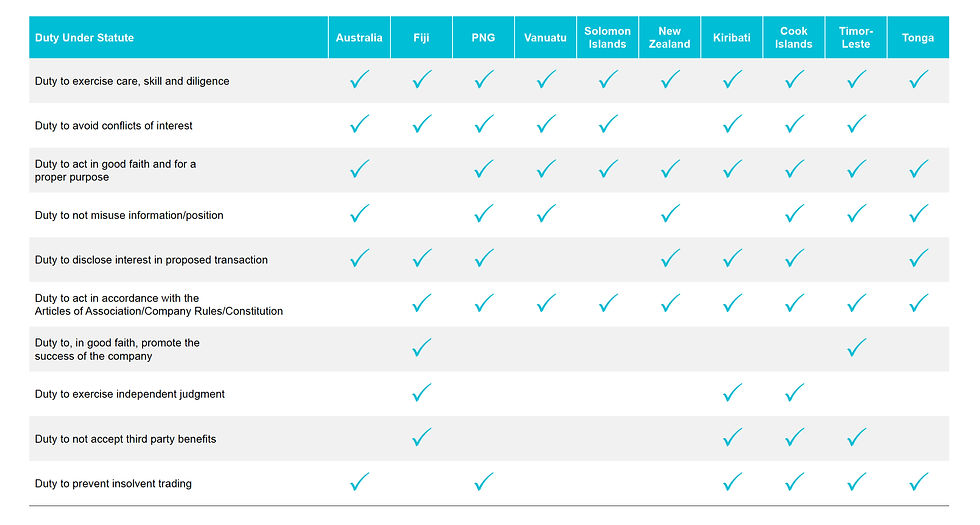
As regulatory expectations continue to evolve in areas such as anti-money laundering, sanctions compliance, climate-related obligations and AI governance, the principles emerging from Bekier provide timely guidance for Pacific boards seeking to strengthen risk oversight and information flows. The decision is therefore not simply an Australian governance case, it is a reminder of the standards of conduct increasingly expected of directors and officers throughout the Pacific region.
The case at a glance
The Star Entertainment Group Limited operated casinos in Sydney and on the Gold Coast. Between 2017 and 2019, Star continued dealing with the Suncity gambling junket despite internal reports and external warnings linking it to organised crime and money laundering. Star also permitted China UnionPay (CUP) debit cards to be used to access funds for gambling, contrary to CUP’s own rules, and provided misleading information to its banker, NAB, about the nature of those transactions.
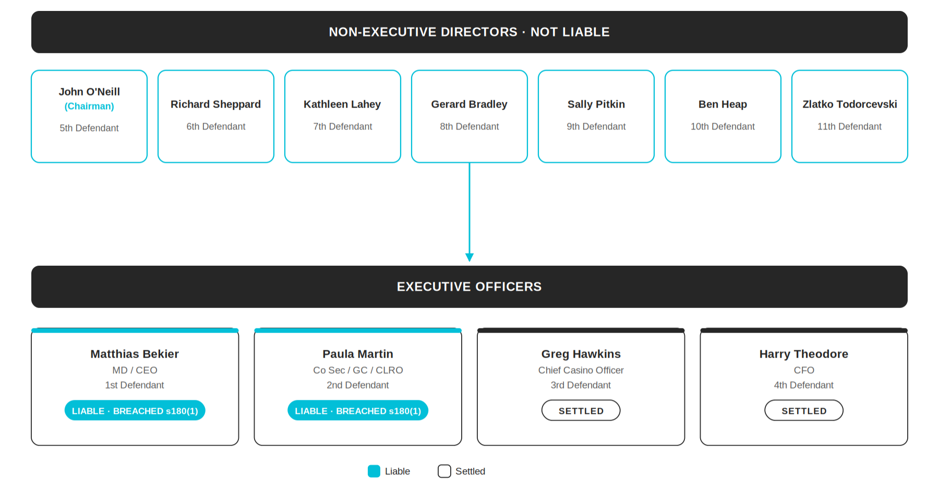
The Australian Securities and Investments Commission (ASIC) commenced civil penalty proceedings against eleven former directors and officers alleging breaches of the statutory duty of care and diligence under section 180(1) of the Corporations Act 2001 (Cth).
The Court found that:
the former Managing Director and CEO Matthias Bekier breached his duty by failing to properly respond to a KPMG report identifying AML deficiencies, failing to manage the risks associated with Suncity, and failing to escalate issues concerning CUP transactions to the Board; and
the former Chief Legal and Risk Officer Paula Martin also breached her duty by failing to advise the Board about Suncity risks and being involved in misleading the company’s bank regarding CUP transactions.
Seven non-executive directors were found not to have breached their duties, as they had not been fully informed by management of the gravity of the risks.
Two further defendants, Mr Hawkins (Chief Casino Officer) and Mr Theodore (CFO), settled prior to trial.
The court's findings
The “information filter”
The central finding against the CEO was that he possessed material information about AML/CTF failures and the risks posed by Star’s dealings with Suncity but did not escalate that information to the Board. Instead, the Board was told that Star was running a “good, clean operation” and that “good levels of compliance” were being maintained.
The Court held that a conscious decision to filter or manage the Board’s exposure to negative information was itself a breach of the duty of care. This was a breach by omission. Mr Bekier failed to recommend that the Board suspend or terminate Star’s relationship with Suncity and failed to inform the Board that the risk picture was materially worse than what Board papers conveyed.
The practical test is this: if you are an executive who holds pieces of information that, taken together, paint a materially different risk picture from what the Board is being told, you have a duty to speak up.
“Two hats, one duty”
Ms Martin held three positions simultaneously: Company Secretary, Group General Counsel, and Chief Legal and Risk Officer. Her argument was that she had reported risks to the CEO (who sat on the Board) and had thereby discharged her obligation.
The Court rejected this. Her obligation as Company Secretary included reporting risks to the Board directly, independent of her reporting line to the CEO as General Counsel. The fact that the CEO also sat on the Board did not excuse her failure to disclose information to the Board separately.
The Court further observed that an officer with legal training may be expected to identify risks that other officers might not appreciate, and that other members of the company are relying on that person to guard against those risks materialising. For General Counsel and in-house lawyers who also hold officer positions, this means heightened expectations in the discharge of the duty of care.
What the non-executive directors got right (and nearly wrong)?
The seven non-executive directors were exonerated because they genuinely did not possess the relevant information. They had received Board packs and management presentations that assured them processes were sound and compliance was being maintained. The Court held they were entitled to rely on management to bring material risks to their attention.
However, Justice Lee was critical of their level of engagement, noting that the contemporaneous minutes disclosed “little by way of sustained scrutiny or insistence upon explanation in circumstances where risks were obvious.” The message is clear: reliance on management is conditional. When circumstances warrant further inquiry, directors must ask probing questions and document that they asked them.
Why this matters across the Pacific?
Justice Lee stated expressly that this is “not a case of novelty in legal principle.” The duty of care and diligence applied in Bekier exists in substantially identical form across the Pacific:
JurisdictionJurisdiction | Equivalent provision |
Australia | Corporations Act 2001 (Cth), s 180(1) – directors and officers must exercise reasonable care and diligence. Breach may result in civil penalties, compensation orders and disqualification. |
New Zealand | Companies Act 1993 (NZ), s 137 – directors must exercise the care, diligence and skill of a reasonable director. |
Papua New Guinea | Companies Act 1997 (PNG), s 115– directors and officers must exercise reasonable care, diligence and skill. |
Fiji | Companies Act 2015 (Fiji), s 106 – directors and officers must exercise reasonable care, skill and diligence. |
Solomon Islands | Companies Act 2009 (Solomon Islands), s 69 – directors owe a duty of care, diligence and skill. |
Vanuatu | Companies Act No. 25 of 2012 (Vanuatu), s 69– directors must exercise reasonable care, diligence and skill. |
Samoa | Companies Act 2001 (Samoa), s 70– directors must exercise reasonable care, diligence and skill. |
Tonga | Companies Act 1995 (Tonga), s 136– directors must exercise reasonable care, diligence and skill. |
Kiribati | Companies Act 2021 (Kiribati), s 93 – directors must exercise the care, diligence and skill of a reasonable director. |
Cook Islands | Companies Act 2017 s 92 – directors must exercise reasonable care and diligence. |
Australian case law is heavily influential in the decision-making of common law courts across the Pacific. The reasoning in Bekier is directly persuasive in all of these jurisdictions. If a similar fact pattern arose in PNG, Fiji or Vanuatu, a court could follow this approach.
For Pacific group structures specifically, the “information filter” risk is structurally amplified. Parent boards in Brisbane, Auckland or Sydney are geographically and operationally remote from subsidiaries in Port Moresby, Suva or Port Vila. Information must travel through multiple layers before it reaches decision-makers, creating opportunities for risks to be delayed, filtered or downplayed at each level. The multi-hat situation where one person serves as Country Manager, Company Secretary, local director and de facto legal adviser, is the norm rather than the exception across the Pacific, making the two-hats principle from Bekier immediately relevant.
Practical recommendations
(Document your escalation triggers) Establish a clear, written protocol identifying the circumstances in which local management must escalate material risks to the regional or parent board. Without defined triggers, important information may slip through the cracks.
(Address the dual-role governance gap) Where an officer holds multiple positions (for example, General Counsel and Company Secretary), ensure the governance framework provides an independent reporting line to the Board that is separate from the management hierarchy. After Bekier, the Board-reporting obligation prevails.
(NEDs: ask probing questions and document them) When presented with reassuring compliance reporting, ask: what are we not seeing? What has changed? Documenting those inquiries provides a contemporaneous record of active engagement.
(Establish a formal AI governance policy) Justice Lee observed that AI may assist directors in processing information, but it cannot displace informed human judgment. If AI tools are being used in the preparation or digestion of Board materials, this should be governed by formal Board policy.
(Review D&O insurance coverage) Confirm that coverage extends to all Pacific jurisdictions in which the group operates, that officers holding multiple roles are captured, and that the policy responds to regulatory investigations that escalate into personal liability proceedings.
If you would like assistance reviewing your governance arrangements, delivering a board governance workshop, or understanding the implications of Bekier for your organisation, please contact the Pacific Legal Network team. We regularly advise directors, officers and executives across the Pacific on governance, risk management and directors' duties.
Further resources
PLN’s Directors’ Duties Guide provides a comprehensive overview of the legal obligations of directors and officers across twelve Pacific jurisdictions. We are currently updating the Guide in light of Bekier and expanding coverage to include Samoa, New Caledonia, the Federated States of Micronesia, the Marshall Islands and Palau. To request a copy, contact our team or visit pln.com.au.
PLN’s own John Ridgway is also hosting a Pacific Board Governance Workshop at the Hilton Fiji Beach Resort & Spa, Denarau Island, Nadi from 23–25 November 2026. The workshop covers governance and the board, strategy and risk governance, and understanding financial statements. Click here for further details.


